


Thousands of workers, students and social activists yesterday threw eggs toward the Presidential Office in Taipei during a protest about various economic and social issues, after launching five parades across the city.
“Fuck the government. It’s garbage,” thousands of demonstrators assembled on Ketagalan Boulevard chanted in unison as they moved toward the Presidential Office.
As they reached police barricades that stopped them about 300m away from the Presidential Office building itself, they began to throw eggs.
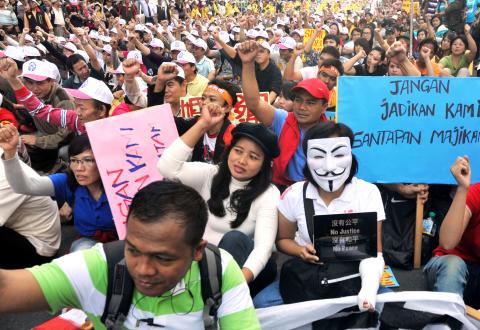
Photo: AFP, Mandy CHENG
Thousands of eggs were thrown over the barricades, accompanied by angry shouts, cheers and whistles.
Zhongzheng First Precinct Police Chief Fang Yang-ning (方仰寧), the commander of the police force at the scene, immediately declared that egg-throwing violated the Assembly and Parade Act (集會遊行法) and asked the crowd to stop or to disband.
However, the protesters continued and soon the ground was covered with egg yolk and cracked eggshells.
Prior to the rally in front of the Presidential Office, the demonstrators had marched across the city in five parades, each representing a social dilemma — including “merchandization” of education, racial discrimination, forced land seizures, a development-oriented economy and deteriorating social insurance systems.
“The demonstration today is a demonstration for all members of the working class and incorporates issues concerning education, environmental protection, agriculture and racial discrimination,” longtime labor activist Lin Tzu-wen (林子文) told the crowd. “In recent years, the government has been leaning more and more toward capitalists, while overlooking the suffering of the general public. It’s time for us to remind them to pay more attention to the people, not the few.”
Taiwan International Workers Association spokesman Hsu Chia-chuan (許家雋) said the government’s recent economic policies sought to trim labor costs by weakening protections for blue-collar foreign workers, while relaxing restrictions on white-collar foreign workers.
“This is not only racial discrimination, but also class discrimination,” Hsu said.
Some of the policies the government is mulling include lowering the threshold on businesses hiring foreign workers and excluding blue-collar foreign workers from the minimum wage.
“So many different groups concerned about different issues are assembled here, because we all face one core issue — the right-wing tendency of this government,” Raging Citizens Act Now spokesperson Lai Hsiang-ling (賴香伶) said.
She said the government was turning education into a commodity, making it increasingly expensive to go to school.
She also said the government was trying to import more cheap labor from overseas, exploiting foreign and domestic workers alike to benefit big business.
“The government is seizing farmland to make way for factories once big corporations demand it. The government is allowing industrial tycoons to expand capacity at expense of the environment,” she said. “Because the government predicts that the labor insurance fund may collapse within two decades, the solution it comes up with is to ask workers to pay higher premiums, accept lower pensions and retire at an older age, while it continues to give tax breaks and other favorable measures to capitalists.”
A retired manager of a Taipei-based trading company surnamed Chang (張) said he came out not only to show his anger against the government, but also his solidarity with his children.
“When I was young, I always believed that you could have a successful life if you worked hard enough, but it doesn’t seem to be the case nowadays,” he said. “My son is an electrical engineer, he works hard, but he still lost his first job when his company moved across the Strait. Not long after he started his second job, he was put on unpaid leave by his boss for some time because of the bad economy.”
“It’s Sunday today, but he still cannot come here, because he’s working overtime on a Sunday shift — he works hard, actually, he works even harder than I did, but I don’t feel as hopeful for him as I did when I was his age,” Chang said.

Taiwan Semiconductor Manufacturing Co (TSMC, 台積電), the world’s largest foundry service provider, yesterday said that global semiconductor revenue is projected to hit US$1.5 trillion in 2030, after the figure exceeds US$1 trillion this year, as artificial intelligence (AI) demand boosts consumption of token and compute power. “We are still at the beginning of the AI revolution, but we already see a significant impact across the whole semiconductor ecosystem,” TSMC deputy cochief operating officer Kevin Zhang (張曉強) said at the company’s annual technology symposium in Hsinchu City. “It is fair to say that in the past decade, smartphones and other mobile devices were
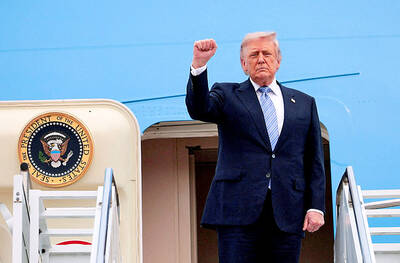
US-CHINA SUMMIT: MOFA welcomed US reassurance of no change in its Taiwan policy; Trump said he did not comment when Xi talked of opposing independence US President Donald Trump yesterday said he has not made a decision on whether to move forward with a major arms package for Taiwan after hearing concerns about it from Chinese President Xi Jinping (習近平). Trump’s comments on Taiwan came as he flew back to Washington after wrapping up critical talks in which both leaders said important progress was made in stabilizing US-China relations even as deep differences persist between the world’s two biggest powers on Iran and Taiwan. “I will make a determination,” Trump said, adding: “I’ll be making decisions. But, you know, I think the last thing we need right
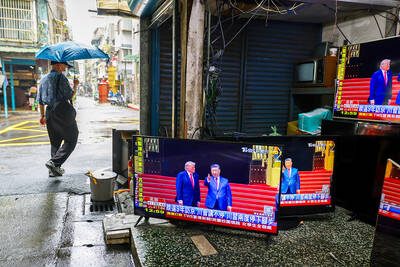
TAIWAN ISSUE: US treasury secretary Scott Bessent said on the first day of meetings that ‘it wouldn’t be a US-China summit without the Taiwan issue coming up’ There were no surprises on the first day of the summit between US President Donald Trump and Chinese President Xi Jinping (習近平), the Mainland Affairs Council (MAC) said yesterday, as the government reiterated that cross-strait stability is crucial to the Asia-Pacific region, as well as the world. As the two presidents met for a highly anticipated summit yesterday, Chinese state media reported that Xi warned Trump that missteps regarding Taiwan could push their two countries into “conflict.” Trump arrived in China with accolades for his host, calling Xi a “great leader” and “friend,” and extending an invitation to visit the White House
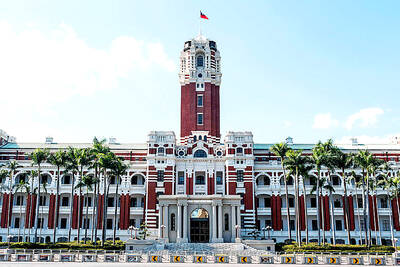
SECURITY: Taipei presses the US for arms supplies, saying the arms sales are not only a reflection of the US security commitment to Taiwan but also serve as a mutual deterrent against regional threats Taiwan is committed to preserving the cross-strait “status quo” and contributing to regional peace and stability, the Presidential Office said yesterday. “It is an undeniable fact that the Republic of China is a sovereign and independent democratic nation,” Presidential Office spokeswoman Karen Kuo (郭雅慧) reiterated, adding that Beijing has no right to claim sovereignty over Taiwan. The statements came after US President Donald Trump warned against Taiwanese independence. Trump wrapped up a state visit to Beijing on Friday, during which Chinese President Xi Jinping (習近平) had pressed him not to support Taiwan. Taiwan depends heavily on US security backing to deter China from carrying


 RSS
RSS